 Saturon
Extensibility & Dynamic Registry
Explore how Saturon's decoupled registry allows you to dynamically inject and unregister custom color spaces, syntaxes, formatters, and algorithms at runtime.
A major challenge in modern color science libraries is future-proofing. As the W3C introduces new CSS color spaces and syntax rules, hardcoded parsers and conversion graphs become rapidly obsolete.
Saturon solves this by treating the engine as a dynamic, bidirectional ecosystem. Built-in color models, syntax rules, and formatters use the exact same underlying architecture as third-party plugins. Because of this, anything registered operates seamlessly as a native core feature—and can be dynamically torn down when no longer needed without leaving stale references or leaking memory.
Here is an architectural breakdown of how Saturon's extensibility engine processes, integrates, and unregisters custom components.
The Public API
Developers interact with the extensibility architecture primarily through two unified entry points: register() and unregister(). Both functions operate on batches to optimize grammar compilation and cache invalidation cycles.
import { register, unregister } from "saturon/registry";

// 1. Batch Registering Custom Logic
register("fit-method", [
    {
        name: "custom-clipping",
        value: (colorData) => {
            /* custom mapping logic */
            return colorData.coords;
        },
    },
]);

// 2. Unregistering by Category and Target Name
unregister("fit-method", ["custom-clipping"]);
These entry points act as unified dispatchers. They route the incoming category (RegistererType) to its corresponding handler in registerers or unregisterers before executing engine-wide cleanup tasks.
1. Symmetric Handlers (registerers & unregisterers)
Under the hood, the architecture avoids monolithic initialization and cleanup logic by dividing responsibilities into two symmetric dictionary modules: registerers and unregisterers.
The architecture supports seven distinct registration categories:
| Category | Purpose | Mutated Engine State |
|---|---|---|
color-function | Injects custom mathematical color functions/models. | colorModels, formatters, parsers, grammarMap |
color-space | Registers matrix-based color spaces using bridge transforms. | colorSpaces, colorModels, parsers, grammarMap |
parser | Injects custom CSS string evaluation logic or grammar nodes. | parsers, grammarMap, validators |
formatter | Appends custom string serialization outputs. | formatters |
shortcut | Defines quick-matching parser overrides. | shortcuts, grammarMap |
fit-method | Injects custom gamut mapping algorithms. | fitMethods |
named-color | Adds hardcoded RGB color lookup tokens. | namedColors |
When unregister() is invoked, the respective unregisterers handler deletes the target key directly from the internal state lookup table (e.g., removing a color model from colorModels or a formatter from formatters), restoring the engine to its pre-plugin state.
2. Dynamic Grammar Mutation & Teardown
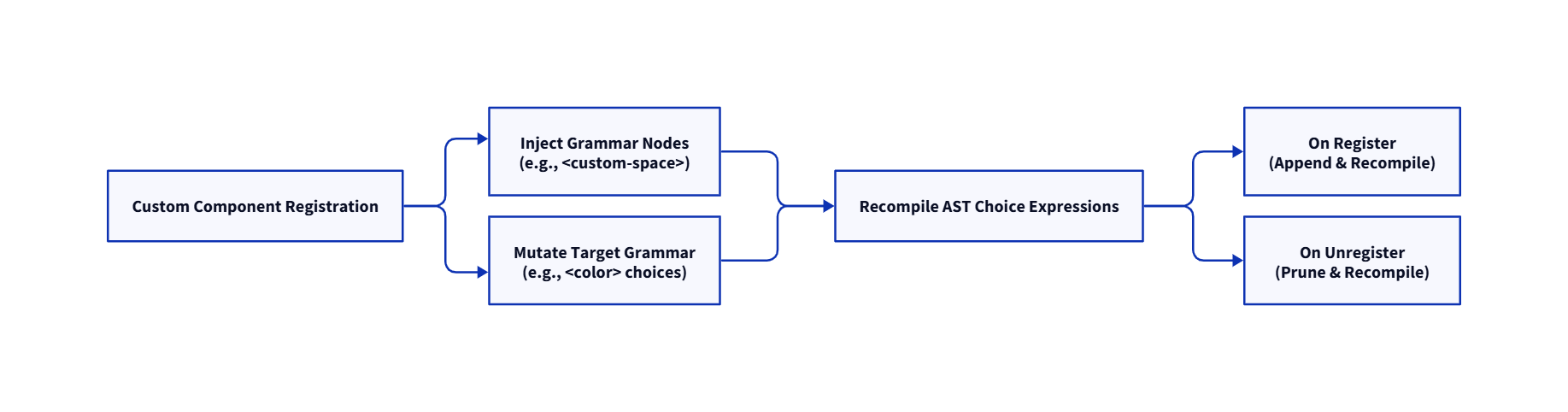
The most powerful feature of the registry is how it dynamically mutates and cleans up the parser's Abstract Syntax Tree (AST) grammar (grammarMap) at runtime.
Auto-Generating Syntax Rules
When a custom "color-function" or "color-space" is registered:
- Saturon inspects its component layout (e.g., checking for polar components like
huevs rectangular coordinates). - It generates complete AST parsing expressions for standard, legacy, and CSS Level 5 Relative Color syntax (
from <color>). - It appends the rule identifier to the internal tracker (
registry.customSpaces,registry.polarFunctions, etc.). - It re-compiles the master non-terminal AST grammar rules (
<custom-color-space>,<custom-polar-space>, or<custom-rectangular-space>) by joining active registry rules into a choice expression (ruleA | ruleB).
Recompiling Grammar on Unregister
When a custom space or rule is removed via unregister():
- The target AST parsing expressions are deleted directly from
grammarMapandparsers. - The item is removed from the
registry.customSpacesset. - The master grammar choice node (e.g.,
<custom-color-space>) is immediately re-evaluated and re-compiled using the updated set values.
If no custom spaces remain, the master choice rule safely evaluates to an empty set, ensuring the CSS parser ignores unregistered syntax without crashing or suffering performance degradation.
The appendTo Extension Pattern
When custom "parser" rules or "shortcut" overrides use the appendTo property, the engine creates a non-destructive dependency chain:
- The original target rule (e.g.,
<color>) is duplicated into a protected<rule-core-base>node. - The primary rule is overridden with a dynamic choice node:
[ <rule-core-base> | <custom-extension> ]. - The original parsers cascade AST node evaluation through the modified tree structure.
3. Cache Invalidation & Graph Cleanup
Saturon relies heavily on a dynamically calculated graph architecture to compute shortest paths (BFS) between color models and cache intermediate conversion matrices.
Introducing or removing nodes while keeping stale graph caches can cause fatal routing errors or invalid transformations:
- Registering a model creates new potential graph pathways that must be discovered.
- Unregistering a model removes a node from the graph. If cached BFS routes still attempt to traverse through this deleted node, runtime conversion calls will crash.
To prevent orphan references, both register() and unregister() automatically invoke cache.clear() upon execution:
// Excerpt from registry lifecycle execution
export function unregister<T RegistererType extends>(type: T, names: Array<...>): void {
    const fn = unregisterers[type];

    for (const name of names) fn(name);

    // Flush graph adjacency matrices, BFS route caches, and conversion memoizations
    if (typeof cache !== "undefined" && typeof cache.clear === "function") {
        cache.clear();
    }
}
Flushing the cache guarantees that the very next color operation recalculates clean adjacency matrices using only active, validated models.
4. Deep Engine Validation
To maintain stability across registration and unregistration lifecycles, registry handlers enforce strict validation checkpoints before committing state changes:
- Type Safety Checks: Confirms matrices (
toBridgeMatrix,fromBridgeMatrix) are strictly formatted as 2D numeric arrays. - Bridge Model Existence: Ensures the declared
bridgeproperty references an actual, existing space incolorModels(preventing disconnected sub-graphs). - Duplicate Prevention: Prevents overwriting existing named colors, formatters, or fit methods without explicit developer intervention.
Once validated, registered components instantly become accessible across all architectural layers. Upon calling unregister(), all associated parsers, grammar rules, formatters, and graph nodes are cleanly excised—leaving zero residual footprint in the engine.